
Advice from sex and relationships expert Ruby Rare, author of The Non-Monogamy Playbook, on handling differing desires around opening up.
Bringing up non-monogamy is vulnerable for everyone involved. It takes courage to ask for change, and it takes just as much courage to express fear or discomfort. But with compassion, communication, and patience, you can navigate these conversations in a way that honours you both. I wrote a lot on this subject in The Non-Monogamy Playbook, and here are some of the key points for you to consider.
Non-monogamy won’t fix a crumbling foundation
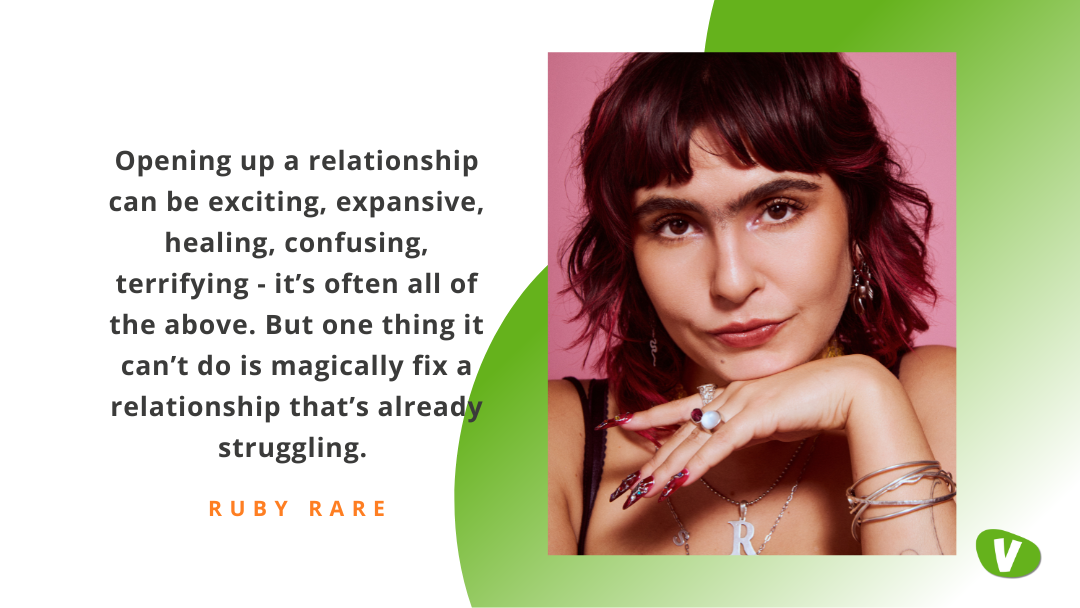
Opening up a relationship can be exciting, expansive, healing, confusing, terrifying – it’s often all of the above. But one thing it can’t do is magically fix a relationship that’s already struggling. Before you even think about dating other people, it’s worth slowing down and looking honestly at where you and your partner are starting from.
Many of us have seen couples try to ‘level up’ their relationship to avoid addressing deeper issues: moving in together, getting a puppy, getting engaged, anything that feels like progress, but in some cases can function as a distraction. It feels like opening up is becoming a modern addition to this group – a shiny new adventure that temporarily masks problems underneath.
I’ve been in non-monogamous relationships for a decade and am a firm believer in how wonderful it can be. But it requires a lot of trust, honest communication, emotional resilience, and a solid baseline of care. If the foundation of your relationship is shaky, opening up usually adds pressure rather than relieving it. And it’s not just about your relationship as a duo – bringing new people into a fragile dynamic can be unfair to them, too.
This isn’t about needing a ‘perfect’ relationship. Every couple has conflicts or unresolved admin. What matters is how you handle those tricky moments, and whether you can talk through them with respect and honesty. Before opening up, try to identify any glaring tensions you haven’t addressed. You don’t need every duck in a neat little row, but you do need to know where the cracks are.
Who usually brings this up?
There’s a stereotype that in man-woman ‘straight presenting’ relationships, it’s always men pushing for non-monogamy. In reality, I’ve seen the opposite far more often: women are also bringing this to the table. I’m aware there’s bias here because I’m living in my queer bubble, but often I see non-monogamy brought up by newly out women who are in a ‘straight-presenting’ relationship, and wanting to explore that part of themselves. This absolutely happens with men, too, but currently it’s less common. When someone is discovering a new aspect of their sexuality, the desire to open up can feel personal and essential, not frivolous.
Wherever you’re coming from, it’s worth considering your partner’s headspace as much as your own.
If you’re the partner coming out
First of all, congratulations! Discovering new things about yourself is beautiful and brave – I’m sending a hug your way.
It’s worth bearing in mind that your partner might be receiving this news much later in your internal journey. You may have been thinking about this for months or years; for them, it’s brand new. Give them some time to catch up.
It can help to connect with queer friends or online communities where you can process openly, rather than relying solely on your partner to hold all your new feelings. You might also consider other ways your partner can help affirm your sexuality beyond opening up: consuming queer media together, going to queer-friendly events, or exploring fantasy and play within your existing relationship.
If you’re the reluctant partner
Maybe your partner has recently come out as queer and wants to explore. Maybe you’re simply comfy in monogamy and don’t feel a need to change things. Your feelings are valid.
It’s normal to feel insecure or destabilised when your partner brings up non-monogamy. You might worry you’re no longer enough, or that this is the start of the end. Give yourself time to process and, importantly, find people you can talk to – friends, community spaces, or a therapist with experience working with non-monogamous clients. Don’t keep those feelings bottled up, and don’t tell your partner only what you think they want to hear. They need to understand your authentic feelings so you can navigate this together.
How to start the conversation about non-monogamy
In an ideal world, you’d both have the same thoughts about non-monogamy at the same time, and you’d happily stroll into openness together. In the real world, conversations often begin from different places.
A mistake I see the initiator make is thinking through the entire concept alone for weeks or months, and then presenting a fully formed plan to their partner, which starts things off with a lot of imbalance: one person is already emotionally invested, while the other is hearing all this for the first time. It can feel like being expected to catch up instantly, which leads to resentment on both sides.
Instead, bring the conversation up early and gently. Something like: “Hey, can I run something by you? I’ve been thinking a bit about non-monogamy, not as a demand but as a curiosity. I’d love to know what you think.”
Frame it as an exploration, not a verdict.
Some practical tips:
- Pick your moment wisely. There’s no perfect time, but there are some objectively awful ones. If you’ve just had a baby (I genuinely know someone this happened to), you’re in the middle of a health crisis, or it’s a particularly stressful time at work – save this conversation for when things calm down.
- Ask for consent before diving in. By checking if this is an ok time to have a conversation, you’re minimising the risk of this coming across as confrontational. It’s up to you to consider the best ways to check in ahead of time, and ensure you’re both in a good headspace to have a big chat – there’s no one-size-fits-all here.
- Offer reassurance. Explain why you’re curious, how you feel about the relationship, and what you’re hoping to understand – not to persuade, but to contextualise. Laying out your thoughts clearly gives less room for doubt and panic, and will help your partner accept what you’re saying at face value. It’s then crucial to properly listen to your partner’s response. Their doubts, reservations, and insecurities that come up are an integral part of how future conversations will go and will guide you in how to approach them.
When you’re happy with things as they are
Here’s the tricky bit, and the reason you might be reading this.
Starting non-monogamy requires consent from both partners. You don’t need identical enthusiasm levels, but you do need genuine willingness from everyone involved. Doing it because you feel pressured, which Dan Savage coined as ‘polyamory under duress’, sets the stage for resentment, hurt, and broken trust.
If you’re the one initiating, ask yourself honestly: are you gently inviting your partner towards a new door… or pulling them through it with their heels dug in?
If you’re the hesitant partner, ask yourself: are you saying no because you truly don’t want this, or because you’re afraid of what the change might mean?
Your answers will likely be complicated – that’s ok, give yourself time to sit with them.
And what if the answer’s still no?
Sometimes, after lots of talking and lots of thinking, one partner remains keen, and the other remains firmly unkeen. There’s no easy resolution here.
You can:
- Agree to revisit in a few months and see if feelings have shifted.
- Look for compromises, like exploring a fantasy together, or one partner remaining monogamous while the other has limited outside experiences, known as a mono-poly arrangement, which some couples thrive in.
- Acknowledge a fundamental incompatibility. This is the hardest outcome, but sometimes the most honest one. If non-monogamy feels like a core part of one partner’s identity, and monogamy feels essential for the other, you may reach an impasse similar to wanting or not wanting children.
The goal isn’t to force sameness. It’s to understand each other’s needs well enough to make informed decisions about staying together, adapting together, or, in some cases, parting with kindness.
If you decide to try opening things up, there’s a whole lot more advice in The Non-Monogamy Playbook to help guide you through this process. Face things as a team, embarking on an exciting new adventure, knowing there’ll be challenges along the way, but with the aim to explore and learn more about yourselves as individuals and as a couple.
For more sex and relationship advice, visit the Vivastreet blog.